
→ Leer este artículo en español
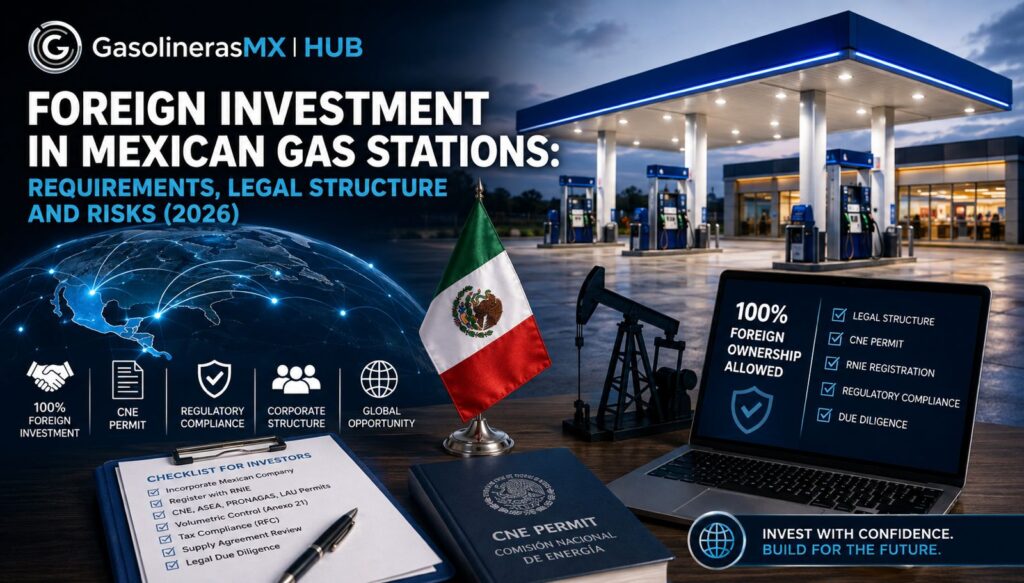
More foreign investors — from private funds to individual buyers in the United States, Central America, and the Middle East — are asking the same question: can a foreigner own a gas station in Mexico? The short answer is yes, and in most cases up to 100%. The longer answer involves a 2014 energy reform, a 1993 foreign investment law, and a corporate structure that has to be built correctly from day one.
This guide covers the applicable legal framework, the recommended structure, the mandatory registrations, and the risks a foreign investor should weigh before committing capital to a Mexican service station.
Can a foreigner own a gas station in Mexico?
Yes. Exploration and Extraction of hydrocarbons is reserved exclusively for the Mexican State under Article 5 of the Foreign Investment Law. But Expendio al Público — retail fuel sale, the actual gas station activity — is not part of that reservation. The 2014 energy reform opened transport, storage, distribution, marketing, and retail sale of petroleum products to private investment, foreign investment included.
In practice, this means a foreigner can hold up to 100% of the capital stock of the Mexican company that holds the retail permit issued by the Comisión Nacional de Energía (CNE, Mexico’s energy regulator).
| Activity | Open to foreign investment? | Limit |
|---|---|---|
| Hydrocarbon exploration and extraction | No | Reserved to the State |
| Transport of petroleum products | Yes | No cap (up to 100%) |
| Storage of petroleum products | Yes | No cap (up to 100%) |
| Distribution of petroleum products | Yes | No cap (up to 100%) |
| Retail sale (gas stations) | Yes | No cap (up to 100%) |
| Land ownership in border/coastal strip (100 km / 50 km) | Conditional | Requires a bank trust if the company has foreign majority ownership |
The only real friction shows up when the station sits inside the restricted strip (100 km from the border or 50 km from the coast): there, land ownership — not the business itself — requires a bank trust (fideicomiso) if the holding company has foreign-majority capital.
The structure: never in a personal capacity
No retail permit is applied for or transferred directly to a foreign individual. The industry-standard structure is:
- Incorporate a Mexican company (typically an S.A. de C.V.) before a notary, with a foreign-admission clause written into the bylaws.
- The CNE permit is applied for, or acquired, in the name of that company — never the individual.
- The company appoints a Mexico-domiciled legal representative with sufficient notarial power to act before CNE, ASEA (the environmental/safety regulator), and the SAT (tax authority).
- The company obtains its RFC (tax ID) and complies with volumetric controls (Anexo 21), NOM-005-ASEA, and NOM-016-CRE like any other operator.
Asset purchase vs. buying the permit-holding company
There are two routes for a foreigner to acquire an operating gas station, and they carry very different implications.
| Asset purchase | Share purchase (permit-holding company) | |
|---|---|---|
| What transfers | Land, facilities, equipment | Controlling stake in the company that owns the permit |
| CNE approval required? | Yes — formal permit assignment | No, for the change of shareholder control itself |
| Liabilities inherited | Only what’s negotiated | All of the company’s (tax, labor, regulatory) |
| Typical closing timeline | Longer (depends on CNE resolution) | Faster to close, but requires deeper due diligence |
| Most common use case | New land, ground-up development | Operating stations with a track record |
Share purchases move faster because they skip the CNE assignment process, but they demand a thorough review of the target company: tax liabilities, pending litigation, permit status (CNE, ASEA, PRONAGAS, LAU), and existing supply contracts. A hidden liability comes attached to the permit.
Mandatory registration: RNIE
Any Mexican company with foreign capital participation — in any proportion — must register with the Registro Nacional de Inversiones Extranjeras (RNIE), administered by Mexico’s Ministry of Economy. Registration is not optional and must be updated whenever shareholders, the foreign-ownership percentage, or the corporate address change. The file itself is confidential and accessible only to the investor, their legal representative, and the authority.
Checklist for the foreign investor
- Incorporate or acquire a Mexican company with a foreign-admission clause
- Appoint a Mexico-domiciled legal representative with notarial power
- Register the company with RNIE within the deadlines set by its regulations
- Check whether the property sits in the border/coastal strip (trust required)
- Run full due diligence if buying an existing company: CNE, ASEA, PRONAGAS, LAU permits, volumetric control, tax liabilities
- Confirm the company’s RFC and applicable tax regime
- Review the current supply agreement (own brand, wholesaler, or Pemex franchise)
- Retain energy-sector legal counsel before signing a letter of intent
Risks foreign investors tend to underestimate
Unresolved estates and title. It’s common in the Mexican gas station resale market to find stations where the original owner passed away and the permit is tied up in an unresolved probate process. Buying without verifying estate status can stall closing for months.
Inherited regulatory liabilities. A station with pending ASEA observations, an out-of-compliance volumetric control system, or an expired PRONAGAS registration can face closure after the deal closes, regardless of who the new owner is.
CNE resolution timelines. Even though the new unified application format (2025) simplified paperwork, resolution times for permit assignments remain variable. Structuring the deal as a share purchase reduces this exposure.
Confidentiality during negotiation. In high-ticket transactions, the exact location and the seller’s identity are typically protected under a confidentiality agreement until the buyer demonstrates financial capacity and signs a formal letter of intent.
Bottom line
Mexico doesn’t restrict foreign investment in the gas station business — it deliberately opened the sector in 2014. The challenge isn’t legal in the sense of permits being denied based on nationality; it’s operational — structuring the company correctly, completing the RNIE registration, and running rigorous due diligence on the permit and the liabilities that come with it. Investors who arrive with the right structure from day one avoid months of regulatory friction after closing.
This article is for informational purposes only and does not constitute legal or tax advice. Before structuring an investment, consult a law firm specialized in Mexican energy and corporate law.
About GasolinerasMX | HUB
GasolinerasMX | HUB is the leading ecosystem for the gas station sector in Mexico. We support owners, investors, operators, and suppliers at every stage of the business, with personalized follow-up on every transaction and the backing of a network of more than 5,000 active contacts.
At GasolinerasMX | HUB you’ll find:
- Brokerage for buying and selling gas stations
- Brokerage for leasing gas stations
- Land for gas station development
- Specialized services: regulatory compliance, permits, volumetric control, rebranding, and infrastructure
- Available investment opportunities
- GasolinerasMX | HUB Supplier Directory — our network of specialized partners
Looking to buy, sell, or lease a gas station, need to comply with current regulations, or want to connect with specialized suppliers in the sector?
Contact us at GasolinerasMX.com or write to us directly on WhatsApp at +52 55 2755 6634.
¿Desea posicionar su empresa en el sector gasolinero?
Publique su empresa en el directorio B2B de GasolinerasMX | HUB y conecte con proveedores, operadores, inversionistas y compradores activos en México.
Ver planes y precios