
→ Leer este artículo en español
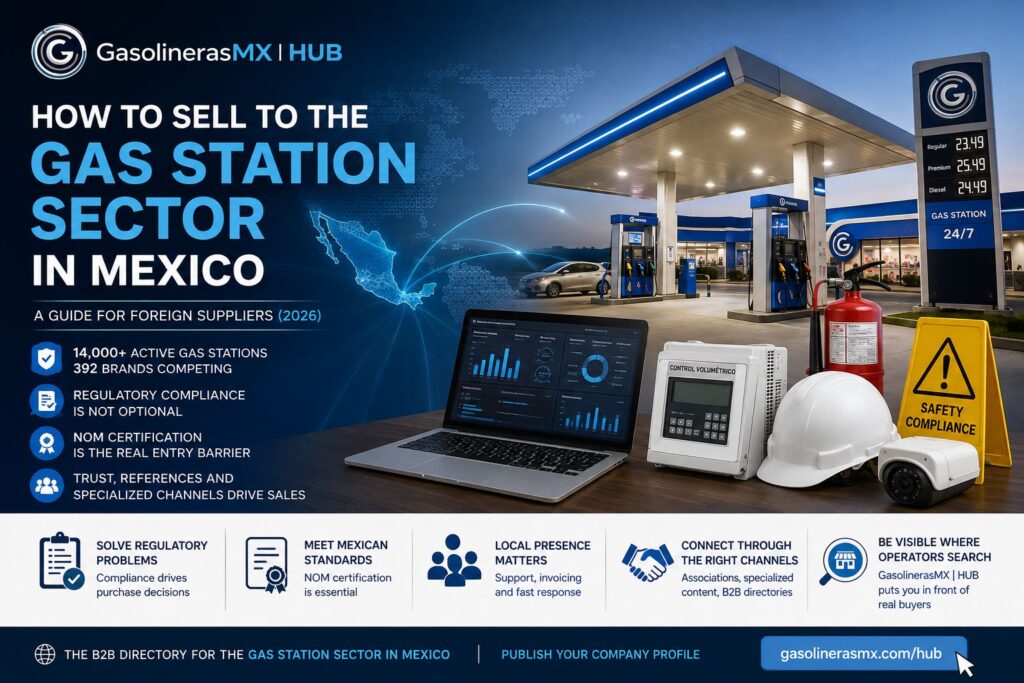
Mexico has more than 14,000 active gas stations and 392 brands competing to differentiate themselves from Pemex. Every one of those stations needs equipment, technology, regulatory compliance tools, uniforms, signage, volumetric control systems, and dozens of other inputs — many of which are sourced from foreign suppliers because the local market doesn’t cover all the technical demand. For a supplier outside Mexico, that’s a real opportunity — but entering the market correctly means understanding how the sector buys, what regulation requires, and where commercial contacts actually come from.
The size of the opportunity
As of the end of April 2026, Mexico’s Comisión Nacional de Energía (CNE) had 14,405 active retail fuel permits on record. The market is no longer just Pemex: 392 private brands are actively competing for market share, which has driven up demand for differentiation — brand image, point-of-sale technology, loyalty systems, safety equipment, and regulatory compliance are ongoing investments for any operator trying to compete.
| Product/service category | Demand level | Regulatory or commercial driver |
|---|---|---|
| Volumetric control systems | High | Mandatory under Anexo 21 (tax authority) |
| Industrial safety equipment | High | Mandatory under NOM-005-ASEA |
| Dispensers and pumps | Medium-high | Fleet renewal, new stations |
| Point-of-sale software / analytics | Medium-high | Commercial differentiation, inventory control |
| Video surveillance and AI | Medium | Security, loss prevention |
| Uniforms and printed supplies | Medium | Constant turnover, brand image |
| Signage and rebranding | Medium | Flag changes (rebranding to a new brand) |
| Environmental consulting (MIA, SASISOPA) | Medium-high | Mandatory for permits and operation |
What a foreign supplier needs to understand before selling here
Regulatory compliance isn’t optional for the buyer — and that’s what sells. A volumetric control system that doesn’t meet Anexo 21 can cost an operator fines of up to 290,000 pesos and the cancellation of digital tax stamps. A safety system that doesn’t meet NOM-005-ASEA can lead to shutdown. That means products that help an operator stay compliant don’t sell as a “nice to have” — they sell as part of an operational risk the station owner is already trying to solve.
NOM certification is the real barrier to entry. Measurement equipment, dispensers, and safety systems without the corresponding Mexican certification (NOM-005, NOM-016, CRE standards) simply cannot be legally installed or sold at a station. Before pursuing sales, a foreign supplier should check whether their product requires NOM certification and, if so, start that process — typically through an accredited certification body — before looking for customers.
Local presence or representation is expected. Most Mexican operators — especially mid-size and large chains — prefer to buy from suppliers who can invoice in Mexico (CFDI), provide technical support in Spanish, and stand behind warranties without relying on case-by-case imports. That doesn’t necessarily mean opening a subsidiary: many foreign suppliers operate through a local distributor or representative while they validate the market.
How commercial contacts actually happen in this sector
Unlike mass-consumer sectors, Mexico’s gas station industry is relatively closed and runs on trust and referrals. Operators don’t look for new suppliers on generic marketplaces — they look in sector-specific sources: industry associations (such as AMPES), technical editorial content, and vertical B2B directories.
That makes the most efficient entry path for a foreign supplier not mass advertising, but presence in the channels where the buyer is already searching for a solution to a specific regulatory or technical problem.
Checklist for the foreign supplier
- Check whether the product requires NOM certification (005-ASEA, 016-CRE, or another applicable standard) before selling
- Decide on an entry model: own subsidiary, local distributor, or sales representative
- Secure the ability to invoice in Mexico (CFDI) or partner with someone who can
- Prepare sales materials in Spanish, framed around a specific compliance or operational problem
- Identify which category of the GasolinerasMX | HUB B2B Directory fits the product/service
- Publish a company profile in the directory, with use cases relevant to the Mexican market
Bottom line
Mexico’s gas station market is large, fragmenting across more brands every year, and buys out of regulatory necessity more than trend — which is an advantage for a foreign supplier who understands how to position against that problem. The right way in isn’t mass advertising; it’s presence where operators are already looking for solutions: specialized technical content and a B2B directory vetted by the sector itself.
At GasolinerasMX | HUB you’ll find:
- Brokerage for buying and selling gas stations
- Brokerage for leasing gas stations
- Land for gas station development
- Specialized services: regulatory compliance, permits, volumetric control, rebranding, and infrastructure
- Available investment opportunities
- GasolinerasMX | HUB Supplier Directory — our network of specialized partners
Looking to buy, sell, or lease a gas station, need to comply with current regulations, or want to connect with specialized suppliers in the sector?
Contact us at GasolinerasMX.com or write to us directly on WhatsApp at +52 55 2755 6634.
¿Desea posicionar su empresa en el sector gasolinero?
Publique su empresa en el directorio B2B de GasolinerasMX | HUB y conecte con proveedores, operadores, inversionistas y compradores activos en México.
Ver planes y precios