
→ Leer este artículo en español
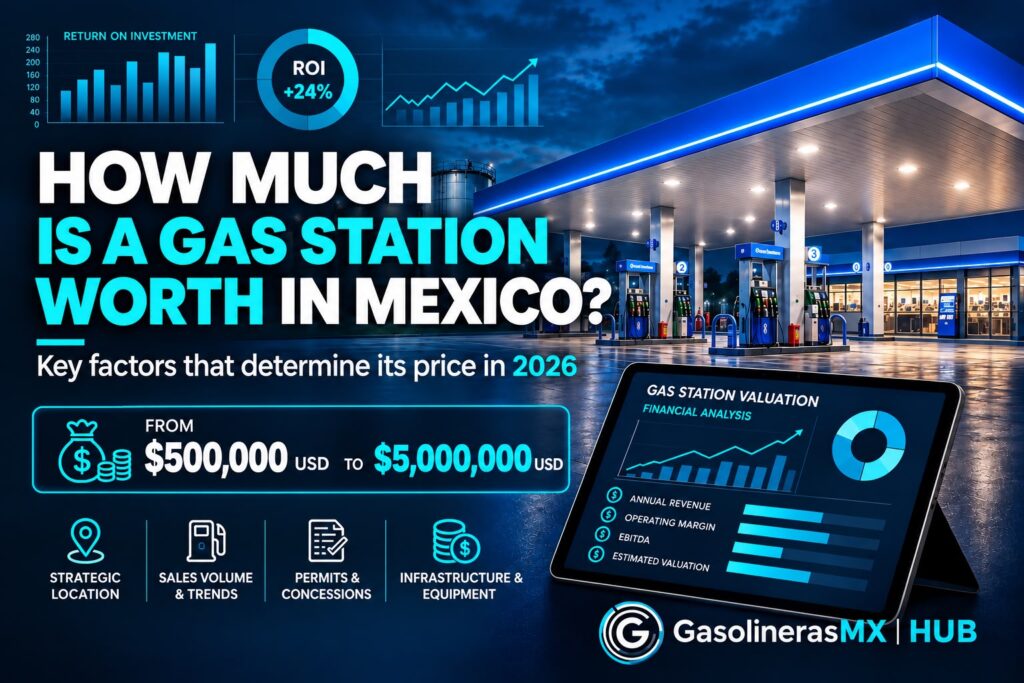
One of the most common questions among people active in Mexico’s gas station M&A market is also one of the hardest to answer with a single number: how much is a gas station worth in Mexico?
The answer depends on multiple factors: sales volume, location, condition of the infrastructure, current permits, and the business’s growth potential. Even so, there are established methodologies and reference ranges that allow for a well-founded estimate of a station’s value.
This guide explains how a gas station’s value is determined, what factors increase or reduce it, and the price ranges the market is working with in 2026. If you’re also looking to understand the full step-by-step valuation process, see our guide How Is a Gas Station Valued in Mexico?
Why Is It Difficult to Value a Gas Station?
Unlike conventional real estate, a gas station’s value doesn’t depend solely on the land or the construction. It’s a business in operation whose value is determined primarily by its capacity to generate income.
Two stations with nearly identical facilities can have very different values if one sells 300,000 liters a month and the other sells 800,000. The difference in cash-flow generation is the main driver of valuation.
Other factors also come into play: the standing of regulatory permits, the condition of underground equipment, the presence of environmental liabilities, and the type of supply contract the station holds.
The Three Main Valuation Methods
1. Sales Volume Multiple Method
This is the most widely used method in the Mexican gas station market because of its simplicity and direct applicability to the business.
Monthly sales volume in liters is taken and a multiple is applied that varies according to local market conditions, the station’s condition, and its growth potential.
2026 reference ranges:
| Monthly sales volume | Estimated value range |
|---|---|
| 100,000 – 200,000 liters | $833,000 – $1,944,000 USD (~$15,000,000 – $35,000,000 MXN) |
| 200,000 – 400,000 liters | $1,944,000 – $3,611,000 USD (~$35,000,000 – $65,000,000 MXN) |
| 400,000 – 700,000 liters | $3,611,000 – $6,111,000 USD (~$65,000,000 – $110,000,000 MXN) |
| 700,000 – 1,000,000 liters | $6,111,000 – $10,000,000 USD (~$110,000,000 – $180,000,000 MXN) |
| Over 1,000,000 liters | $10,000,000 USD and up (~$180,000,000 MXN and up) |
These ranges are for reference only and can vary significantly depending on location, the condition of the infrastructure, and local market conditions.
2. EBITDA Multiple Method
EBITDA (earnings before interest, taxes, depreciation, and amortization) is a standard measure of operating profitability. In the gas station sector, stations typically trade at 4 to 8 times annual EBITDA.
Example:
- Estimated monthly EBITDA: $11,100 USD (~$200,000 MXN)
- Annual EBITDA: $133,300 USD (~$2,400,000 MXN)
- Multiple applied: 6x
- Estimated value: $800,000 USD (~$14,400,000 MXN)
Stations with greater operational stability, a better location, and higher ancillary income tend to justify higher multiples within the range.
3. Replacement Cost Method
This method estimates how much it would cost to build and bring an equivalent station into operation from scratch. It’s used mainly as a value floor in negotiations: an operating station should always be worth more than its replacement cost, because it already has valid permits, an established customer base, and proven cash flow.
The cost of developing a new gas station in Mexico typically runs between $1,000,000 and $1,944,000 USD (~$18,000,000 – $35,000,000 MXN), not including the land. That marks an important reference point in negotiations.
Factors That Increase a Gas Station’s Value
Not all stations with the same sales volume are worth the same. These are the factors that push a station’s value above the average for its segment:
| Factor | Why it increases value |
|---|---|
| Strategic location | Primary avenues, city exits, industrial corridors, or high-traffic highways sustain current volume and protect against competition |
| Current, in-order regulatory permits | Active CNE permits, ASEA registrations, and up-to-date tax obligations remove uncertainty for the buyer |
| Infrastructure in good condition | Recent tanks, modern dispensers, and certified volumetric metering reduce the immediate investment the buyer must make |
| Diversified revenue | A convenience store, commercial units, or a café provide a more stable and diversified cash flow |
| Favorable supply contract | Good pricing, guaranteed volume, and a reliable supplier are an asset that transfers with the station |
| Track record and reputation in the area | Years of operation and an established customer base are an intangible value that sophisticated buyers recognize |
Factors That Reduce a Gas Station’s Value
Likewise, certain factors can cause a station to trade below the average for its segment:
| Factor | Impact on negotiation |
|---|---|
| Environmental liabilities (soil contaminated by spills or leaks) | Remediation can cost several hundred thousand dollars and take months or years; it’s negotiated with a significant discount, or the seller must remediate before closing |
| Obsolete or poorly maintained equipment | Tanks over 20 years old or uncertified dispensers mean immediate investment that gets deducted from the price |
| Expired permits or regulatory irregularities | Any pending legal or administrative issue is grounds for a price adjustment or a suspensive condition |
| High staff turnover or labor disputes | In a continuous-operation business, this represents real operational risk |
| Excessive dependence on a single product or channel | A station without ancillary income is more vulnerable to margin swings |
How Is a Gas Station’s Price Negotiated?
Buying and selling gas stations in Mexico typically follows a process that includes:
1. Preliminary evaluation. The seller shares basic operating information: sales volume, operating costs, permits, and equipment condition. The buyer performs an initial valuation. If you’re the seller, this stage can be done confidentially — without disclosing the exact location or your identity — as explained in our guide How to Sell Your Gas Station in Mexico Without Exposing Yourself.
2. Letter of intent. The parties set preliminary terms: a reference price, general conditions, and an exclusivity period for due diligence.
3. Due diligence. The buyer reviews financial statements, contracts, regulatory permits, tax standing, equipment condition, and possible environmental or legal liabilities in detail.
4. Price adjustment and closing. Based on due diligence findings, the final price is adjusted and closing terms are structured.
5. Permit transfer. This is the most delicate and time-consuming step in the process. Transferring the CNE permit and updating registrations with ASEA, the SAT, and other authorities requires specialized handling and can take several months.
Considering buying or selling a gas station? See the opportunities available at GasolinerasMX or learn about our specialized advisory services.
Is 2026 a Good Time to Buy a Gas Station in Mexico?
Market conditions in 2026 are favorable for those evaluating a gas station acquisition:
Sustained demand growth. Mexico’s vehicle fleet continues to expand, and logistics activity driven by nearshoring has increased diesel consumption along industrial and highway corridors.
Station shortage in key regions. In areas of high economic and demographic growth, the supply of stations hasn’t kept pace with demand, which protects the margins of existing stations.
Greater market transparency. Digitization of regulatory records and greater availability of sector data allow for more informed investment decisions than a decade ago.
Diversification as a value lever. Stations that add ancillary services generate higher returns and have greater resale value, which makes investment in upgrades recoverable.
Conclusion
A gas station’s value in Mexico in 2026 is determined mainly by its sales volume, its location, and the standing of its permits and infrastructure. A well-located mid-size station can be worth between $1,944,000 and $3,611,000 USD ($35,000,000 – $65,000,000 MXN), while high-volume stations in strategic locations can exceed $5,555,000 USD ($100,000,000 MXN).
Beyond the number, the key is understanding which specific factors raise or lower the value of each particular station, and having specialized advisory support to carry out rigorous due diligence before any transaction. If your next step is selling, do it without exposing your operation: learn how in How to Sell Your Gas Station in Mexico Without Exposing Yourself.
Sources
- Secretaría de Energía (SENER): gob.mx/sener
- Comisión Nacional de Energía (CNE): gob.mx/cne
- Agencia de Seguridad, Energía y Ambiente (ASEA): gob.mx/asea
- Asociación Mexicana de Proveedores de Estaciones de Servicio (AMPES): ampes.mx
About GasolinerasMX | HUB
GasolinerasMX | HUB is the go-to ecosystem for Mexico’s gas station sector. We support owners, investors, operators, and suppliers at every stage of the business, with personalized follow-up on every deal and the backing of a network of more than 5,000 active contacts.
At GasolinerasMX | HUB you’ll find:
- Brokerage for buying and selling gas stations
- Brokerage for leasing gas stations
- Land for gas station development
- Specialized services: regulatory compliance, permits, volumetric control, rebranding, and infrastructure
- Investment opportunities available
- GasolinerasMX | HUB Supplier Directory — our network of specialized partners
Looking to buy, sell, or lease a gas station, need to comply with current regulations, or want to connect with specialized suppliers in the sector?
Contact us at GasolinerasMX.com or write to us directly on WhatsApp at +52 55 2755 6634.
Want to position your company in the gas station sector?
List your company in the GasolinerasMX | HUB B2B directory and connect with suppliers, operators, investors, and active buyers in Mexico.
¿Desea posicionar su empresa en el sector gasolinero?
Publique su empresa en el directorio B2B de GasolinerasMX | HUB y conecte con proveedores, operadores, inversionistas y compradores activos en México.
Ver planes y precios