
→ Leer este artículo en español
Amounts below are shown in USD, with the original MXN figure in parentheses, converted at an approximate rate of 17 MXN per USD (August 2026). The exchange rate fluctuates — use it as a reference, not an exact quote.
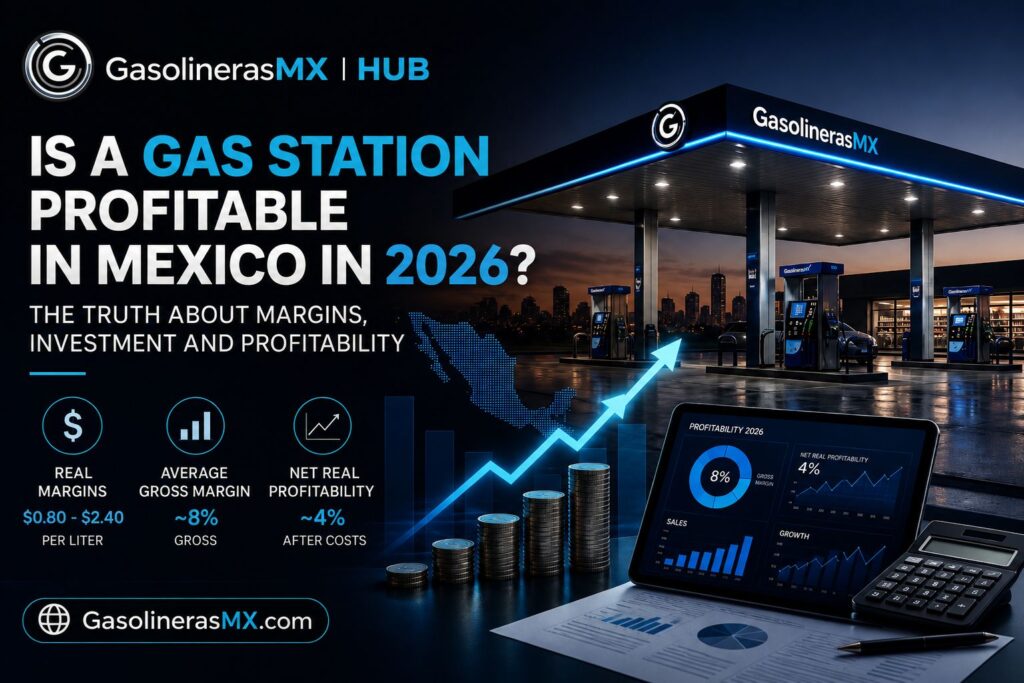
Investing in a service station remains one of the most closely analyzed financial decisions in Mexico’s energy sector. The question is valid and deserves a direct answer, backed by real data: is a gas station still profitable in 2026?
The short answer is yes, with important nuances. A service station’s profitability depends on location, sales volume, the operating model, and the owner’s ability to diversify income beyond fuel.
In this analysis we break down the factors that determine whether a gas station is a solid business or a high-risk investment.
Why gas stations remain attractive businesses in 2026
Mexico’s gas station market is going through a moment of transformation, not decline. There are structural reasons that sustain the sector’s profitability:
Constant, predictable demand. Mexico’s vehicle fleet exceeds 60 million units and continues to grow. Gasoline and diesel remain the dominant fuel for national transport, with a transition to electric vehicles that, in the Mexican context, is projected to be gradual over the next 10 to 15 years.
Nearshoring as a catalyst. The reconfiguration of global supply chains has driven the installation of industrial parks and logistics hubs in the north and center of the country. That generates greater demand for cargo transport fuel, directly benefiting stations located on industrial and highway corridors.
Coverage deficit. According to sector data, Mexico has an estimated deficit of 12,000 service stations to adequately serve its territory. That means in many areas demand exceeds available supply, which protects the margins of existing stations.
High cash flow. Unlike other businesses, a gas station generates constant daily income. That cash flow is especially valued by investors seeking assets with operating liquidity.
The revenue model of a service station
To evaluate profitability, it’s necessary to understand where a modern gas station’s income comes from.
Fuel: the main engine
Primary income comes from the commercial margin per liter sold: the difference between the price at which the station owner buys fuel from their distributor and the price at which they sell it to the public.
In 2026, that operating margin sits in a range of $0.03 to $0.09 USD per liter (~$0.50 to $1.50 MXN), with variations depending on:
- Monthly purchase volume (higher volume = better supplier pricing)
- Distance to the storage terminal
- Level of competition in the area
- Type of brand flag or branding scheme
Complementary income: the difference between good and excellent
The most profitable stations have built a revenue portfolio that goes well beyond fuel:
| Revenue source | Estimated share of total income |
|---|---|
| Fuel | 60% – 75% |
| Convenience store / minimart | 10% – 20% |
| Commercial unit leasing | 5% – 15% |
| Coffee shop / food franchise | 5% – 10% |
| Automotive services | 3% – 8% |
Stations that have well developed their complementary income can see it reach up to 40% of the business’s total income.
To learn more about this model, see our article on leasing commercial units at gas stations.
How much a gas station sells in Mexico
Monthly sales volume is the variable with the greatest impact on profitability. The ranges by station type are:
| Station type | Liters sold per month |
|---|---|
| Small (rural area or low traffic) | 100,000 – 200,000 liters |
| Medium (average urban area) | 300,000 – 500,000 liters |
| High (main road or highway corridor) | 700,000 – 1,500,000 liters |
Location is the factor that most determines which range a station falls into. A gas station on a primary avenue in a mid-sized city can easily exceed 500,000 liters per month, while one in a neighborhood without heavy vehicle traffic will hardly reach 150,000.
Is it profitable? Real monthly profit estimates
Combining sales volume and margins, these are the monthly net profit ranges a gas station in Mexico can generate in 2026:
Small station
- Volume: 150,000 liters/month
- Average margin: $0.70/liter
- Gross fuel income: $6,200 USD (~$105,000 MXN)
- Operating costs: $5,300 – $5,900 USD (~$90,000 – $100,000 MXN)
- Estimated net profit: $300 – $880 USD/month (~$5,000 – $15,000 MXN)
Medium station
- Volume: 400,000 liters/month
- Average margin: $0.90/liter
- Gross fuel income: $21,200 USD (~$360,000 MXN)
- Operating costs: $10,600 – $12,900 USD (~$180,000 – $220,000 MXN)
- Estimated net profit: $8,200 – $10,600 USD/month (~$140,000 – $180,000 MXN)
High-volume station
- Volume: 900,000 liters/month
- Average margin: $1.10/liter
- Gross fuel income: $58,200 USD (~$990,000 MXN)
- Operating costs: $20,600 – $29,400 USD (~$350,000 – $500,000 MXN)
- Estimated net profit: $28,800 – $37,600 USD/month (~$490,000 – $640,000 MXN)
These figures correspond only to fuel income. With well-developed complementary income, profit can increase by an additional 20% to 40%.
How much you need to invest to open a gas station
Profitability must be evaluated in the context of the investment required:
| Item | Estimated range |
|---|---|
| Land | Variable by location and region |
| Construction and infrastructure | $470,000 – $1,176,000 USD (~$8,000,000 – $20,000,000 MXN) |
| Equipment (tanks, dispensers, systems) | $176,000 – $470,000 USD (~$3,000,000 – $8,000,000 MXN) |
| Permits and regulatory procedures | $29,000 – $88,000 USD (~$500,000 – $1,500,000 MXN) |
| Initial working capital | $59,000 – $176,000 USD (~$1,000,000 – $3,000,000 MXN) |
| Estimated total investment | $1,059,000 – $2,059,000 USD (~$18,000,000 – $35,000,000 MXN) |
With a monthly profit of $8,200 to $10,600 USD (~$140,000 to $180,000 MXN) at a medium station, the investment payback period can range between 11 and 16 years, depending on financing and operational efficiency.
For more detail on development costs, see our article on how much it costs to open a gas station in Mexico.
Factors that can reduce profitability
An honest evaluation must also consider the sector’s risks:
High competition in saturated areas. In large cities and corridors with multiple stations, margins tend to compress. Before investing, competitive analysis within a 2 to 5 kilometer radius is essential.
Rising regulatory compliance costs. Obligations before CRE, ASEA, SAT, and STPS have increased significantly in recent years. Volumetric control, electronic tax reporting, and regulatory audits represent costs that must be budgeted for.
Theft and shrinkage. At stations without adequate control systems, losses from internal theft or fuel shrinkage can represent between 1% and 3% of monthly sales volume, directly impacting profit.
Exchange rate dependency. International oil prices and currency fluctuations influence fuel prices. Although the station owner’s margins are relatively independent of the retail price, consumer perception of price can affect traffic.
Long-term energy transition. Transport electrification is a real trend, though its impact in Mexico is projected to be gradual. Investors with a 15- to 20-year horizon should consider how to diversify the station toward services compatible with electric vehicles.
Buy, lease, or build a gas station from scratch?
How you enter the business also affects profitability and risk:
Buying an operating gas station is the option with the highest initial cost but the least uncertainty: the sales history allows for more precise projection of expected returns.
Leasing a gas station allows you to operate the business with less initial capital, though it involves contractual commitments and a reduced profit margin due to lease costs.
Developing a gas station from scratch offers greater return potential, but requires considerable capital, development time (12 to 24 months), and more active management of the regulatory and construction process.
Explore available gas station purchase, sale, and lease opportunities on GasolinerasMX.
What the most profitable gas stations do differently
Sector analysis reveals common patterns among the top-performing stations:
Location on high-traffic corridors. The most profitable stations are on primary roads, city exits, or cargo transport corridors — not in residential areas.
Diversified income portfolio. Convenience store, coffee shop, commercial unit leasing, and automotive services complement fuel income and raise total business profit.
Strict operational control. Volumetric control systems, staff supervision, and regular internal audits significantly reduce losses from shrinkage and theft.
Customer service as a differentiator. In areas with multiple stations, service quality and customer experience are factors that retain consumers and maintain sales volume.
Conclusion
Yes, a gas station remains a profitable business in Mexico in 2026, provided the right location is chosen, it’s operated efficiently, and income sources are diversified beyond fuel.
A well-managed medium-sized station can generate net profits of $8,200 to $10,600 USD per month (~$140,000 to $180,000 MXN) from fuel alone, with the potential to significantly increase that result through complementary services.
For investors with a long-term view and willingness to actively manage the business, the gas station sector remains one of the most solid assets in the Mexican business portfolio.
Sources
- Secretaría de Energía (SENER): gob.mx/sener
- Comisión Reguladora de Energía (CRE): gob.mx/cre
- Agencia de Seguridad, Energía y Ambiente (ASEA): gob.mx/asea
- Asociación Mexicana de Proveedores de Estaciones de Servicio (AMPES): ampes.mx
About GasolinerasMX | HUB
GasolinerasMX | HUB is the leading ecosystem for the gas station sector in Mexico. We support owners, investors, operators, and suppliers at every stage of the business, with personalized follow-up on every transaction and the backing of a network of more than 5,000 active contacts.
At GasolinerasMX | HUB you’ll find:
- Brokerage for buying and selling gas stations
- Brokerage for leasing gas stations
- Land for gas station development
- Specialized services: regulatory compliance, permits, volumetric control, rebranding, and infrastructure
- Available investment opportunities
- GasolinerasMX | HUB Supplier Directory — our network of specialized partners
Looking to sell, lease, invest, or connect with suppliers in the gas station sector?
Contact us at GasolinerasMX.com or write to us directly on WhatsApp at +52 55 2755 6634.
¿Desea posicionar su empresa en el sector gasolinero?
Publique su empresa en el directorio B2B de GasolinerasMX | HUB y conecte con proveedores, operadores, inversionistas y compradores activos en México.
Ver planes y precios