
→ Leer este artículo en español
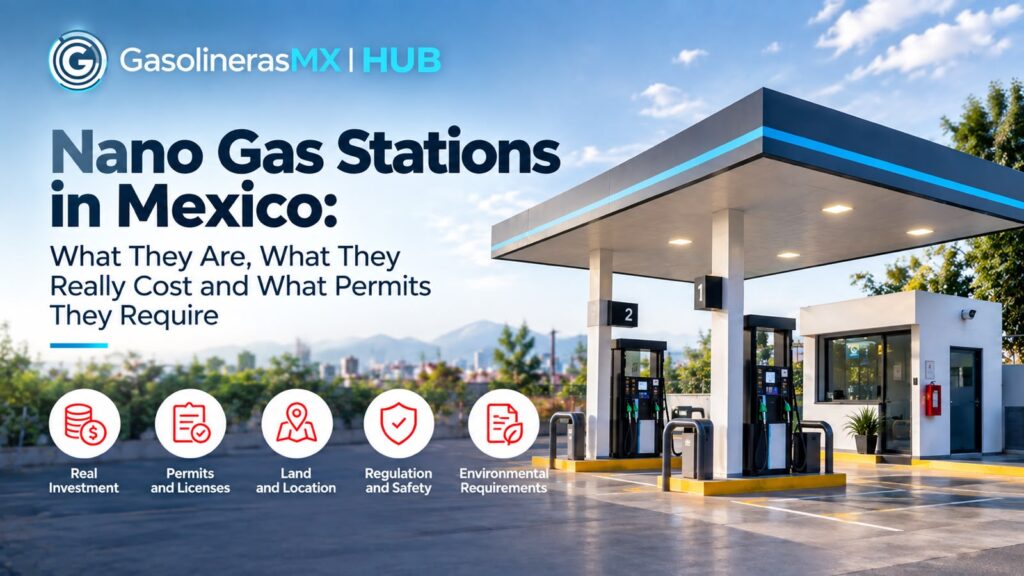
Over the past few years, the term “nano gas station” has become common on social media and among people exploring Mexico’s fuel-retail sector for the first time. The pitch is appealing: a smaller station, at a fraction of the investment of a conventional one, sometimes advertised at around $500,000 USD or even less. Before committing a budget on that assumption, it’s worth understanding what a nano gas station actually is, what current regulation does — and does not — say about it, and what investment range genuinely applies.
What Is a Nano Gas Station? Is It an Official Category?
“Nano gas station” is not a permit category recognized by Mexico’s National Energy Commission (CNE) or by Pemex. It’s a commercial term, used mainly by construction firms, consultants, and some private brands, to describe small-footprint stations aimed at small towns, narrow urban lots, or investors looking for a smaller-scale project than a standard highway or urban station.
What matters is that, since it isn’t a distinct regulatory figure, a “nano” station must meet exactly the same technical, environmental, and safety requirements as any other gas station in Mexico. There is no simplified permitting track, no specific NOM for reduced lots, and no differentiated treatment before the CNE or Mexico’s Safety, Energy and Environment Agency (ASEA).
Lot Size: How “Nano” Can a Site Actually Be
For a standard station with 4 to 6 dispensing positions, the typical operating minimum falls between 1,500 and 3,000 m², factoring in maneuvering space for the fuel truck, mandatory safety setbacks between tanks and structures, and adequate vehicle access. Projects marketed as “nano” try to shrink that footprint, in some cases to lots of a few hundred square meters, generally with just one or two dispensing positions and no convenience store or added services.
The critical point is that shrinking the lot does not shrink the safety distances the regulation requires between storage tanks, dispensers, property lines, and roadways. A poorly sized “nano” lot may simply not be viable once those criteria are applied, regardless of what was marketed. That’s why, before putting down a deposit or signing anything, it’s essential to verify land-use permission, minimum road frontage, and safety setbacks with an independent engineer or permitting specialist — not only with whoever is selling the turnkey project.
Permits: The Same Ones, No Shortcuts
A nano gas station requires the same regulatory path as any gas station in Mexico:
- Retail fuel-sale permit from the CNE, the central authorization to sell fuel to the public.
- Environmental impact authorization from ASEA, mandatory due to hydrocarbon handling.
- Compliance with NOM-005 and NOM-006, covering design, construction, and operation of service stations.
- A volumetric control system, mandatory regardless of projected sales volume.
- Municipal land-use and construction permits, plus civil-protection clearance.
None of these steps has a “lite” version for smaller-scale projects. Typical timelines for a station built from raw land — nano or not — still run 18 to 36 months between permitting, construction, and start of operations.
What Does a Nano Gas Station Really Cost?
This is usually where the gap is widest between what’s promised on social media and what the project actually requires. It’s common to find content claiming a complete “nano” project for $500,000 USD (roughly $9-10 million pesos) or even less, including land. Those figures usually leave out the actual cost of equipment the regulation requires: certified tanks, dispensers, a vapor-recovery system, a volumetric control system homologated with the tax authority (SAT), civil works with the corresponding safety setbacks, and permitting fees for the CNE and ASEA processes.
As a reference, construction cost for a compact station — without a convenience store or car wash, and excluding land — typically falls between $18 and $35 million Mexican pesos. Reducing the number of dispensers or the lot size can push a project toward the lower end of that range, but it doesn’t move it outside of it, because safety systems, volumetric control, and regulatory compliance don’t scale down proportionally with lot size. Anyone quoted well below that range for a “nano” project should ask for the full itemized breakdown before committing any deposit.
Can You Get a “Concession” From Pemex for a Nano Project?
People approaching this topic often talk about seeking a “concession” from Pemex. Strictly speaking, there is no Pemex concession to operate a gas station: what exists is the Pemex Franchise, a brand-licensing scheme that a station joins once it already holds its own valid retail permit from the CNE. In other words, the authority that grants permission to sell fuel is the energy regulator, not Pemex; the franchise is, after that, a separate commercial decision about which brand to operate under.
This distinction matters because it changes the order of priorities for any nano project: first, the lot is validated and the retail permit is processed; only afterward — if that’s the decision — does the owner apply to join the Pemex Franchise or another market brand.
Before Putting Down a Deposit
- Verify land use and safety setbacks on the lot with a party independent from the project’s seller.
- Request a full breakdown of the investment: land, civil works, equipment, permits, and permitting fees, itemized separately.
- Confirm whether the project includes processing the CNE retail permit from scratch, or whether it relies on an already-existing permit.
- Distinguish between the regulatory process (CNE, ASEA) and the branding decision (Pemex franchise or another), which are independent processes.
Frequently Asked Questions
Is “nano gas station” an official CNE term?
No. It’s a market term used to describe stations on reduced lots; regulation does not recognize this as a separate category.
Does a nano gas station require fewer permits than a standard one?
No. It requires the same CNE retail permit, the same ASEA environmental authorization, and the same compliance with NOM-005 and NOM-006.
Is it realistic to invest only $500,000 USD in a project like this?
It’s a figure that circulates on social media, but it rarely includes the full equipment and permitting costs the regulation requires. The real range for compact construction, excluding land, typically falls between $18 and $35 million Mexican pesos.
Can I get a direct concession from Pemex?
There is no “concession” figure with Pemex. The permit to sell fuel is granted by the CNE; the Pemex Franchise is a separate, later process for brand licensing.
About GasolinerasMX | HUB
GasolinerasMX | HUB is the B2B ecosystem for Mexico’s gas station sector, offering personalized support and a network of over 5,000 industry contacts. We offer:
- Brokerage for buying, selling, and leasing gas stations
- Land for new station development
- Specialized regulatory compliance services
- Investment opportunities in the sector
- Provider Directory, our network of specialized partners
Looking to buy, sell, or lease a gas station, need to comply with current regulations, or want to connect with specialized industry providers? Reach out at GasolinerasMX.com or message us directly on WhatsApp at +52 55 2755 6634.
¿Desea posicionar su empresa en el sector gasolinero?
Publique su empresa en el directorio B2B de GasolinerasMX | HUB y conecte con proveedores, operadores, inversionistas y compradores activos en México.
Ver planes y precios