
→ Leer este artículo en español
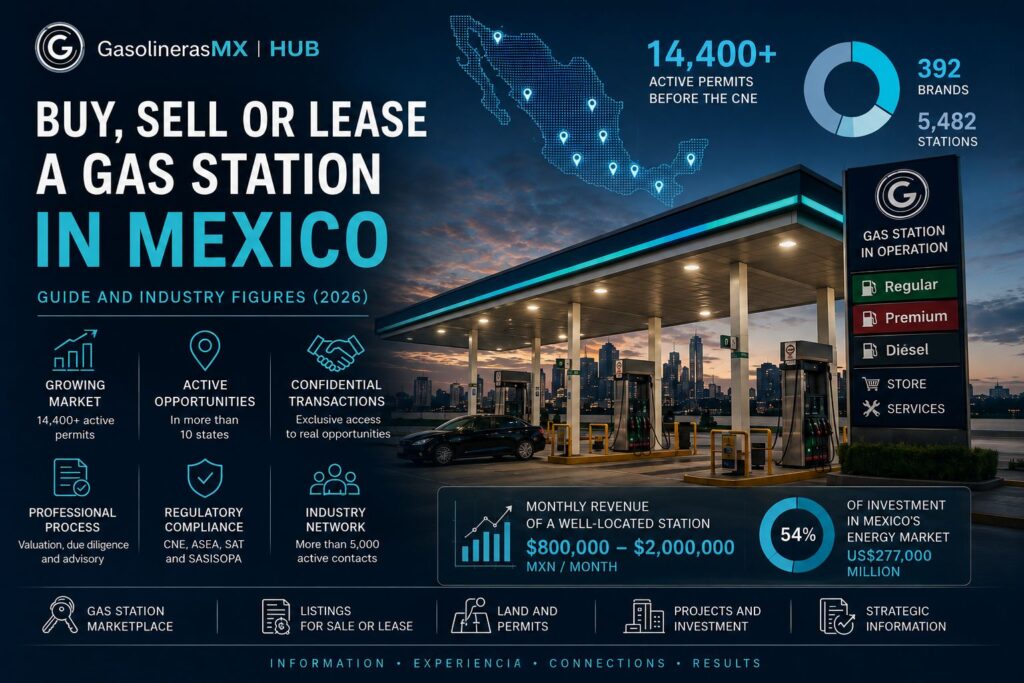
Mexico’s gas station sector is going through its most active period since the energy market opened: more than 14,400 active retail permits, nearly 400 brands competing with Pemex, and a wave of consolidation that is redefining who operates each station. Against that backdrop, buying, selling, or leasing a gas station has stopped being an informal deal between industry contacts and become a process that demands reliable information, technical valuation, and — above all — discretion. This guide brings together the most recent market figures, explains what each type of transaction involves legally and financially, and shows how to access real opportunities — many of which never reach a public listing.
Mexico’s gas station market, in numbers
Before getting into the buying and selling process, it helps to size up the market you’d be entering. Here is the most recent data available on the sector:
| Indicator | 2026 figure | Source / reference |
|---|---|---|
| Active retail permits with the CNE | 14,400+ (highest figure since the market opened) | CNE / PetroIntelligence, April 2026 |
| Non-Pemex brands in operation | 392 brands, 5,482 stations | PetroIntelligence, April 2026 |
| Market concentration (top 3 brands) | Pemex, Mobil, and G500 hold ~70% of stations | Petróleo y Energía, January 2026 |
| Cost to build a new gas station | $1.06M – $2.06M USD (~$18M – $35M MXN), depending on location, project size, infrastructure, and equipment | GasolinerasMX HUB, 2026 |
| Energy investment within Plan México | 54% of a $277 billion USD portfolio | El Financiero, May 2026 |
Note: USD figures are approximate, converted at a reference rate of ~17 MXN per USD; the exchange rate fluctuates.
The takeaway is clear: the number of active permits keeps growing, but the market is increasingly concentrating around well-capitalized operators with professional acquisition processes. Groups that can’t access reliable information about available stations get shut out of the best opportunities, most of which close before ever going public. You can dig deeper into the market’s geographic distribution in our analysis of how many gas stations exist in Mexico and our overview of the brands operating the national market.
What exactly transfers in a gas station sale?
A gas station isn’t just land with equipment on it — it’s a package of regulated assets that transfer simultaneously.
| Asset | What it includes |
|---|---|
| Physical infrastructure | Underground tanks, piping, dispensers, vapor recovery system, civil works, and fueling island |
| CNE retail permit | Active authorization to sell fuel to the public; without it, the station cannot legally operate |
| Branding (abanderamiento) contract | Agreement with the brand (Pemex, BP, Shell, Gulf, or another): supply, image, and territorial exclusivity |
| Volumetric control system | Equipment and service contracts for the fiscal metering system required by SAT (Mexico’s tax authority) |
| Corporate client portfolio | Fleet supply contracts, when applicable — these often represent significant added value |
Legal structures: buying the asset vs. buying the company
| Direct asset purchase | Acquisition of the operating company | |
|---|---|---|
| What is acquired | Real estate and infrastructure | Controlling stake in the operating entity |
| CNE permit | Requires a formal transfer process with the authority | Transfers with the company; no CNE approval needed for the change of control |
| Estimated timeline | Several months (depends on the regulatory process) | Faster to close |
| Main risk | Low, in terms of inherited liabilities | Buyer assumes the company’s full tax, labor, and legal history |
| Recommended when | There are inheritance disputes, litigation, or an unclear tax history | The company has a clean history and speed is a priority |
The choice between the two routes depends on the buyer’s profile and the holding company’s history. For stations where the permit remains under the name of a deceased titleholder while an inheritance process is being resolved, a direct asset purchase tends to be the more orderly path, though also the slower one.
What determines the price of a gas station?
Monthly fuel volume is the most decisive value indicator: a station selling 150,000 liters a month has a very different valuation from one dispensing 900,000. Other factors adjust the baseline from there:
- Location and vehicle traffic in the surrounding area
- Condition of the underground infrastructure and dispensing equipment
- Validity and terms of the CNE permit
- Branding partner and terms of the current supply contract
- Whether the property is owned or leased, and under what conditions (amount, remaining term, renewal option)
- Existing corporate fleet supply contracts
- Secondary income: convenience store or commercial units on the property
Before requesting a formal offer, the valuation process requires gathering information such as total lot size and ownership status, products sold at the station, brand and term of the branding contract, tank capacity, number and brand of dispensers, volumetric system brand, average monthly sales volume and its breakdown by product, and income from convenience-store or commercial space. That information forms an initial valuation and, if there’s mutual interest, a letter of intent that opens the door to a more detailed document checklist before a formal offer is structured.
Leasing a gas station: growing volume without tying up capital
Leasing an operating station is an increasingly common alternative for gas station groups in expansion. It lets an experienced operator take over daily operations without the capital outlay of a purchase: they pay a fixed or variable rent to the owner, who retains title to the permit and the property. It’s especially relevant in two scenarios common in today’s market:
- Stations reverting when a branding contract with a foreign brand expires (BP, Repsol, and others), where the owner weighs re-branding independently, selling, or leasing to a third party experienced in rebranding. We cover this scenario in more depth in our article on options when a branding contract ends.
- Owners with no interest in direct operation, who prefer steady rental income while keeping the asset and the permit in their name.
Due diligence: risks you can’t afford to overlook
Before signing any transaction, it’s essential to verify the station’s full regulatory compliance: validity of the CNE permit, compliance with ASEA’s NOM-005 and NOM-006, correct operation of the volumetric control system required by SAT, and compliance with the SASISOPA operational safety management system. A station with pending observations in any of these areas can see its valuation compromised or, in severe cases, face a shutdown before the deal closes. It’s also worth reviewing situations that aren’t always obvious on a first visit: permits still under the name of a deceased individual while an inheritance is being settled, leased land with a term close to expiring, or exclusivity clauses in the branding contract that limit the buyer’s options.
Where the active opportunities are today
There are currently operating stations available for purchase or lease in states including Baja California, Estado de México, Guerrero, Jalisco, Puebla, and Sonora, with volumes ranging from 90,000 to more than 590,000 liters per month. Availability changes frequently, since a large share of deals close before ever appearing on a public listing.
| State | Municipality | Monthly volume | Lot size | Transaction type |
|---|---|---|---|---|
| Baja California | Tijuana | 210,000 L | 2,400 m² | Sale |
| Estado de México | Valle de Chalco | 90,000 L | 3,200 m² | Sale |
| Guerrero | Ixtapa Zihuatanejo | 590,000 L | 1,504 m² | Sale |
| Jalisco | Guadalajara | 250,000 L | Land not included | Sale |
| Puebla | San Pedro | 150,000 L | 401 m² | Sale |
| Sonora | Hermosillo | 150,000 L | 992 m² | Sale |
Check our gas stations for sale and lease section for the full, up-to-date listing of available stations. If you’re looking at a new development, also review land for gas stations, available CNE permits, commercial units at gas stations, and storage plants. To compare the cost of building versus acquiring an operating station, see our build vs. buy comparison and our 2026 sector profitability analysis.
Why manage your transaction through GasolinerasMX | HUB
Confidentiality is a structural part of this market: a station’s exact location and financial details are shared only with qualified profiles. Unlike a generic listing, GasolinerasMX | HUB’s process is designed to protect both the owner who is selling or leasing and the buyer who is investing:
- Profile qualification before sharing sensitive information, so owners never expose their station publicly.
- Access to a network of 5,000+ active industry contacts — gas station groups, independent operators, and investors.
- Support throughout the process: initial valuation, letter of intent, document checklist, and offer structuring.
- Nationwide coverage, with active opportunities across more than a dozen states and a constantly updated inventory.
- Specialized, current content on regulation, permits, and industry trends, so every decision is made with up-to-date information rather than generic data.
How the process works, step by step
- Contact and profile qualification. We identify the reason for interest (buying, leasing, selling, or looking for land).
- Initial valuation. Based on volume, location, infrastructure, and permit status, we share options aligned with the requester’s interest.
- Letter of intent. If there’s mutual interest, we request a more detailed document checklist for the specific station.
- Formal offer and closing. With complete information, an offer is structured and the process is supported through closing.
Frequently Asked Questions
What permits should I verify before buying a gas station in Mexico?
The active retail permit with the CNE is the most critical, but you should also check compliance with ASEA’s NOM-005 and NOM-006, the SASISOPA system, and correct operation of the volumetric control system required by SAT.
How long does a gas station sale take?
It depends on the structure. A direct asset purchase, since it requires transferring the CNE permit with the authority, usually takes several months. Acquiring the holding company speeds up the change of control, though it requires a more thorough document review.
Is it better to buy the asset or the company that operates the station?
It depends on the buyer’s profile and the holding company’s history. Buying the asset is more transparent in terms of legal liability; buying the company is faster for the change of control, but it means inheriting the company’s full tax and legal history.
What does leasing a gas station involve, and who can lease one?
It’s a structure where an experienced operator takes over a station’s daily operations, paying rent to the owner, who retains title to the permit and the property. It’s common among expanding groups and stations reverting when a branding contract with a foreign brand expires.
How many gas stations are there in Mexico currently?
As of the end of April 2026, the CNE has more than 14,400 active gasoline and diesel retail permits on record — the highest figure since the market opened — with nearly 400 brands other than Pemex in operation.
In which states are gas stations currently available?
As of this publication, there are active opportunities in Baja California, Estado de México, Guerrero, Jalisco, Puebla, Sonora, and Veracruz, among others. Availability updates constantly as deals close.
Ready to explore opportunities in Mexico’s gas station market?
A significant share of the sector’s opportunities is handled confidentially and never publicly listed. By completing the contact form in the buy, sell, and lease section, we identify your profile and share options aligned with your interest — including stations, land, permits, and off-market projects.
About GasolinerasMX | HUB
GasolinerasMX | HUB is the go-to ecosystem for Mexico’s gas station industry. We support owners, investors, operators, and suppliers at every stage of the business, with personalized follow-up on every transaction and the backing of a network of 5,000+ active contacts.
At GasolinerasMX | HUB you’ll find:
- Brokerage for buying and selling gas stations
- Brokerage for leasing gas stations
- Land for gas station development
- Specialized services: regulatory compliance, permits, volumetric control, branding, and infrastructure
- Investment opportunities
- GasolinerasMX | HUB Supplier Directory — our network of specialized partners
Looking to buy, sell, or lease a gas station, need to meet current regulations, or want to connect with specialized industry suppliers?
Contact us at GasolinerasMX.com or write to us directly on WhatsApp at +52 55 2755 6634.
¿Desea posicionar su empresa en el sector gasolinero?
Publique su empresa en el directorio B2B de GasolinerasMX | HUB y conecte con proveedores, operadores, inversionistas y compradores activos en México.
Ver planes y precios