
→ Leer este artículo en español
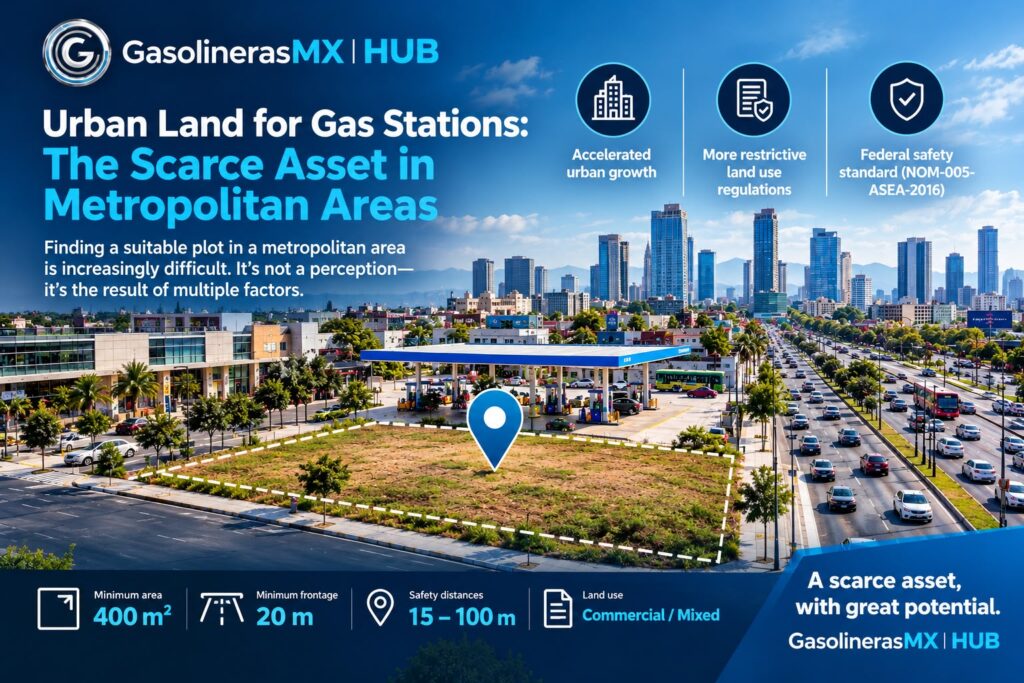
Every year it gets harder to find a plot inside a Mexican metropolitan area that combines compatible zoning, code-compliant dimensions, and a location on a high-traffic corridor — all at once. That’s not a perception; it’s the result of fast urban growth, increasingly strict municipal zoning, and a federal safety standard that sharply narrows the pool of viable sites. The outcome is an asset that becomes scarcer — and more valuable — with every passing year.
Why is urban land suitable for gas stations running out?
Three forces are squeezing the supply of eligible land inside consolidated urban areas:
- Real estate pressure on the same commercial land. The high-traffic corridors that matter for a gas station — primary avenues, highway exits, high-density intersections — are exactly the same corridors that shopping-plaza developers, pharmacies, restaurants, and banks are competing for. A gas station isn’t just competing with another gas station; it’s competing for the land itself against every high-value commercial use.
- Increasingly restrictive zoning changes. Many municipalities have tightened the criteria for authorizing gas-station-specific zoning inside already-consolidated areas, particularly along corridors with mixed residential use or near vertical residential developments.
- A federal safety standard that disqualifies land by design, not by municipal discretion. Even when municipal zoning is favorable, NOM-005-ASEA-2016 imposes minimum safety setbacks and lot dimensions that eliminate, from the outset, a significant share of the land available in consolidated urban areas — regardless of whether the municipality has any objection at all.
This combination explains why, unlike other commercial uses, an urban plot with real gas-station potential can’t easily be swapped for “the lot next door”: the technical requirements act as an additional filter on a market that’s already shrinking under pressure from competing commercial uses.
What the standard requires: setbacks, lot size, and minimum frontage
NOM-005-ASEA-2016, issued by Mexico’s National Agency for Industrial Safety and Environmental Protection of the Hydrocarbons Sector (ASEA) and published in the Federal Official Gazette (DOF) on November 7, 2016, sets the technical restrictions every plot must meet before the CNE will grant an expendio (retail fuel) permit. These restrictions apply nationwide and cannot be waived at the municipal level.
Minimum safety setbacks to external elements
| Restricted element | Minimum distance | Measured from |
|---|---|---|
| Places of public gathering (hospitals, schools, markets, auditoriums, and similar) and any mass-transit or electrified transport system | 15.0 m (~49 ft) | Vertical axis of the fuel dispenser |
| LP gas storage and distribution plants | 100.0 m (~328 ft) | Nearest gas storage tank to the property line |
| Broadcast/radiocommunication antennas, high-voltage lines, railways, and petroleum product pipelines | 30.0 m (~98 ft) | Storage tank to the vertical projection of the element |
| LP gas fueling stations | 30.0 m (~98 ft) | Between storage tanks |
The 15-meter setback from “places of public gathering” is, in practice, the one that disqualifies the most urban land: in a consolidated urban area it’s common to find a school, clinic, market, or transit stop within that radius, ruling out plots that would otherwise have ideal zoning and location.
Minimum lot size and frontage
| Regulatory requirement (NOM-005-ASEA-2016, Table 1) | Minimum |
|---|---|
| Minimum lot size | 400 m² (~4,300 sq ft) |
| Minimum main frontage | 20 linear meters (~65 ft) |
It’s worth distinguishing this legal minimum from the commercially viable minimum: 400 m² and 20 m of frontage are the legal floor for a project to be designed at all, but a standard station with 4 to 6 fueling positions, maneuvering space for tanker trucks, and the functional areas required by the architectural project (access points, machine room, hazardous-waste storage, offices) typically needs between 1,500 and 3,000 m² to operate comfortably. In consolidated urban areas, finding that much square footage with sufficient frontage on a primary avenue is, again, the bottleneck.
The standard adds a further condition on lot geometry: when the frontage meets the lot at an angle other than 90°, or when the depth is smaller than the frontage, the tanker truck must be able to enter, maneuver — including any reversing — and exit entirely within the property, without encroaching on the public street. In practice, this rules out many irregularly shaped urban lots or lots with shallow depth, even when they meet the minimum square-footage requirement.
Other relevant design restrictions
- Gas stations may not be installed underneath vehicular overpasses.
- Minimum turning radii considered in design are 6.00 m for cars and 10.40 m for tanker trucks or heavy vehicles — a condition that in practice demands more maneuvering area than the 400 m² legal minimum suggests.
- Stations built along highways must sit outside the right-of-way and require their own acceleration and deceleration lanes.
Municipal zoning: the other half of the filter
Meeting NOM-005-ASEA-2016 isn’t enough on its own. Independently and in addition, the lot must hold commercial, mixed-use, or gas-station-specific zoning from the relevant municipality. In consolidated urban areas, this zoning-change process is getting harder to obtain, especially along corridors where the municipality prioritizes residential use or has limited new stations due to perceived corridor saturation.
The combination of both filters — federal safety code and municipal zoning — is the underlying reason a piece of urban land that clears both becomes an asset with rising value: it isn’t easily substitutable, and demand to enter these markets hasn’t slowed down.
Why demand keeps pressing on an ever-scarcer supply
Despite the restrictions, both Pemex-branded and private-brand operators continue seeking presence on high-traffic corridors inside metropolitan areas. The reason is simple: dispensing volume depends directly on the vehicle traffic passing the station, and metro areas concentrate the country’s highest vehicle density. That steady demand, against a supply of eligible land that shrinks every year, is what keeps the appreciation of this type of land ahead of the broader commercial real estate market. This dynamic isn’t limited to major metro areas: Mexico carries a national deficit estimated at 10,000-12,000 stations, with nearshoring corridors competing directly for the same type of urban and semi-urban land.
Frequently asked questions
What is the minimum legal lot size for a gas station in Mexico?
NOM-005-ASEA-2016 sets 400 m² (~4,300 sq ft) of lot size and 20 linear meters (~65 ft) of main frontage as the regulatory minimum, though a commercially viable station with multiple fueling positions typically needs between 1,500 and 3,000 m².
How far must a gas station be from a hospital or school?
The standard requires a minimum distance of 15.0 meters (~49 ft), measured from the vertical axis of the dispenser, to places of public gathering such as schools, hospitals, or markets, as well as to mass-transit or electrified transport systems.
Is municipal zoning approval enough to build?
No. Municipal zoning is a necessary but independent condition from compliance with NOM-005-ASEA-2016. A lot can carry commercial zoning and still fail to qualify if it doesn’t meet the federal standard’s safety setbacks and dimensions.
Do you own land with these characteristics?
At GasolinerasMX | HUB we connect land with gas-station development potential to investors and developers actively seeking a presence in Mexico’s metropolitan markets. If you own urban land with compatible zoning, or are looking for one, reach out through our contact form or write to us directly on WhatsApp at +52 55 2755 6634 — many of these opportunities are handled confidentially and are not published openly.
See available land for gas stations →
You may also be interested in:
- Terrenos para Gasolineras en México: Qué Buscar y Cómo Funciona el Mercado (Spanish)
- Where to Build a Gas Station in Mexico? High-Potential and Deficit Zones (2026)
- ¿Conviene Construir o Comprar una Gasolinera? (Spanish)
- How Much Is a Gas Station Worth in Mexico?
- The GasolinerasMX | HUB Directory: The B2B Platform for Suppliers to Mexico’s Gas Station Industry
About GasolinerasMX | HUB
GasolinerasMX | HUB is the B2B ecosystem for Mexico’s gas station sector, offering personalized guidance and a network of 5,000+ active contacts across every link of the business. Our services include:
- Brokerage for buying, selling, and leasing gas stations
- Identifying and placing land for new station development
- Specialized services: permits, regulatory compliance, construction, and infrastructure
- Access to investment opportunities not publicly listed
- Supplier Directory: a network of specialized allies supporting our guidance
Looking to buy, sell, or lease a gas station, need to meet current regulations, or want to connect with specialized suppliers in the sector? Contact us at GasolinerasMX.com or write to us directly on WhatsApp at +52 55 2755 6634.
Sources: Diario Oficial de la Federación (Mexico’s Federal Official Gazette), NORMA Oficial Mexicana NOM-005-ASEA-2016, “Diseño, construcción, operación y mantenimiento de Estaciones de Servicio para almacenamiento y expendio de diésel y gasolinas,” published November 7, 2016. Comisión Nacional de Energía (CNE).
¿Desea posicionar su empresa en el sector gasolinero?
Publique su empresa en el directorio B2B de GasolinerasMX | HUB y conecte con proveedores, operadores, inversionistas y compradores activos en México.
Ver planes y precios