
→ Leer este artículo en español
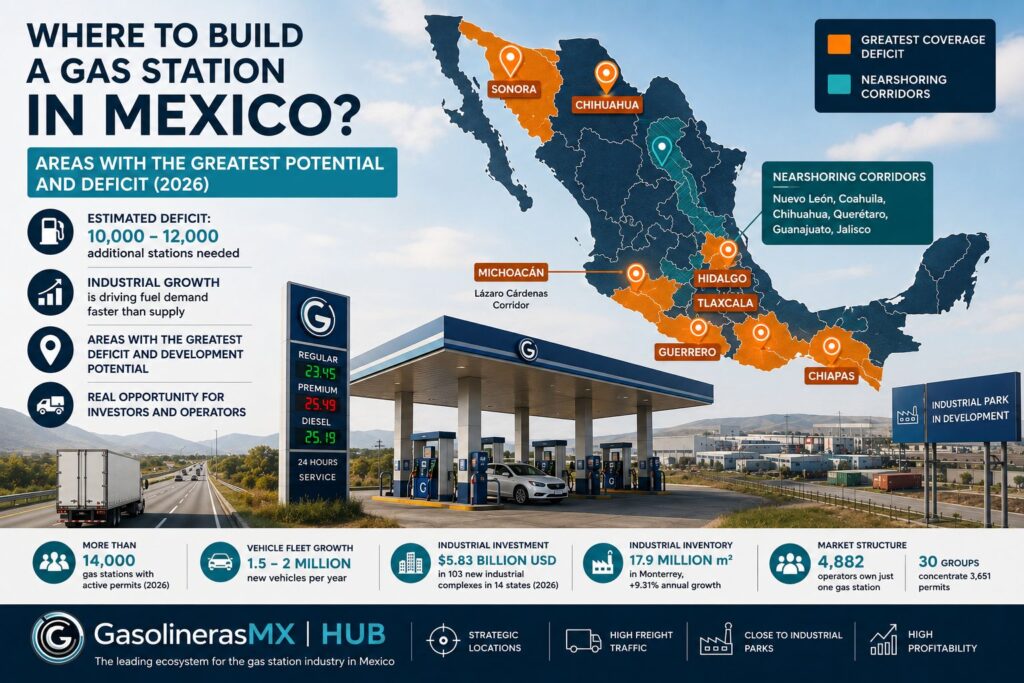
Mexico has between 14,000 and 15,000 gas stations with a current permit in 2026 — a number that sounds large until it’s measured against the size of the country, the vehicle fleet, and the highway network. Against that benchmark, the Mexican market is clearly underserved: the sector estimates a deficit of between 10,000 and 12,000 additional stations to meet current and projected demand. For an investor, Mexican or foreign, that gap is the single most important question to answer before deciding where to build or operate: it isn’t whether there’s room in the market — it’s where that room actually is.
This guide maps the areas with the greatest coverage deficit and the regions where industrial growth is generating fuel demand faster than supply infrastructure can keep up.
The real size of the deficit
The most widely used international benchmark for coverage is the ratio of vehicles to service stations. In mature energy markets, that ratio runs between 1,000 and 1,500 vehicles per station. Mexico, with a vehicle fleet growing by 1.5 to 2 million new units per year and a station network that hasn’t grown at the same pace, runs above that standard across much of the territory — resulting in overloaded stations in some areas and a complete absence of coverage in others.
Onexpo, the sector’s trade organization, has flagged the need for thousands of additional stations to meet national demand — a figure that has been revised upward as vehicle fleet growth and industrial activity accelerate.
States and regions with the greatest coverage deficit
Not all of the country has the same level of need. These are the areas the sector identifies with the widest gap between supply and demand:
| Region | Why it has a deficit |
|---|---|
| Chiapas, Oaxaca, and Guerrero | Large territorial extension, expanding highway network, few stations along intermediate stretches |
| Chihuahua and Sonora | Vast distances where the gap between stations can be critical for freight transport |
| Michoacán (Lázaro Cárdenas corridor) | Growing port and industrial traffic that station coverage hasn’t kept pace with |
| Hidalgo and Tlaxcala | Industrial growth with fuel demand that already exceeds local supply |
These areas share a pattern: economic, population, or freight-traffic growth moving faster than fuel supply infrastructure.
Nearshoring is creating demand where infrastructure doesn’t exist yet
The factor moving the needle most in 2026 isn’t just geographic — it’s industrial. The relocation of manufacturing to Mexico (nearshoring) has concentrated in the Northern and Bajío corridors, and the pressure on that infrastructure is already measurable:
- Nuevo León is the national epicenter: more than 2.1 million formal jobs tied to manufacturing and more than 45 industrial parks running at 97.2% occupancy — demand comfortably outpaces available industrial space.
- Coahuila and Chihuahua round out the border block, with industrial vacancy of just 1% to 3%, generating waitlists for new facilities.
- Querétaro, Guanajuato, and Jalisco anchor the corridor connecting Guadalajara to the north, with cities like Torreón, Celaya, and León gaining industrial prominence.
- The Monterrey industrial market closed the first quarter of 2026 with an inventory of 17.9 million square meters, up 9.31% year-over-year.
- For 2026, an investment of $5.83 billion USD is projected for the construction of 103 new industrial complexes across 14 states.
Every new plant, distribution center, or industrial facility installed in these corridors represents a steady flow of freight vehicles that need fuel — and in many of these areas, new gas station development hasn’t kept pace with the industrial parks growing around it.
Where the market is already saturated (and why to avoid it)
Knowing where the deficit is matters just as much as knowing where not to compete. The states with the highest concentration of stations — Estado de México, Jalisco, and Veracruz — already have considerably higher supply density than the rest of the country. That doesn’t mean there’s no opportunity there (a well-positioned specific site in a high-traffic zone can still be profitable), but competition for those spots is higher and margins tend to be tighter than in areas of genuine deficit.
Market structure favors the individual investor
One relevant data point for anyone evaluating entry into the sector: Mexico’s gas station market is highly fragmented. There are 6,186 business groups linked to fuel retail in the country, of which 4,882 own just a single station. At the other extreme, only 30 groups control 3,651 permits. This means the market isn’t dominated by a handful of chains — there’s real room for new operators, both for ground-up development and for acquiring existing stations in deficit areas.
What to evaluate before choosing a location
With the national picture as context, the decision of where to build or operate comes down to site-specific variables:
- Distance to the nearest station along the corridor (gaps of 50–100+ km between stations are strong candidates)
- Daily vehicle traffic on the road, especially freight transport
- Proximity to active or under-construction industrial parks
- Projected population growth and urban expansion in the area
- Land use and regulatory viability of the site for a CNE permit
- Presence (or absence) of direct competition within a 2–5 km radius
Bottom line
Mexico’s gas station deficit isn’t uniform — it’s concentrated in specific regions where population, industrial, or highway growth is outpacing fuel supply infrastructure. For an investor, that turns the question of “where to build or operate?” into a data-driven decision rather than an intuitive one: the nearshoring corridors in the North and the Bajío, and the states with the largest territorial extension and lowest coverage, hold the clearest potential in the market in 2026.
About GasolinerasMX | HUB
GasolinerasMX | HUB is the leading ecosystem for the gas station sector in Mexico. We support owners, investors, operators, and suppliers at every stage of the business, with personalized follow-up on every transaction and the backing of a network of more than 5,000 active contacts.
At GasolinerasMX | HUB you’ll find:
- Brokerage for buying and selling gas stations
- Brokerage for leasing gas stations
- Land for gas station development
- Specialized services: regulatory compliance, permits, volumetric control, rebranding, and infrastructure
- Available investment opportunities
- GasolinerasMX | HUB Supplier Directory — our network of specialized partners
Looking to buy, sell, or lease a gas station, need to comply with current regulations, or want to connect with specialized suppliers in the sector?
Contact us at GasolinerasMX.com or write to us directly on WhatsApp at +52 55 2755 6634.
¿Desea posicionar su empresa en el sector gasolinero?
Publique su empresa en el directorio B2B de GasolinerasMX | HUB y conecte con proveedores, operadores, inversionistas y compradores activos en México.
Ver planes y precios