
→ Leer este artículo en español
Amounts below are shown in USD, with the original MXN figure in parentheses, converted at an approximate rate of 17 MXN per USD (August 2026). The exchange rate fluctuates — use it as a reference, not an exact quote.
Buying a gas station in Mexico is one of the most complex — and best-compensated — investment decisions in the private business sector. It is also one of the most poorly executed — not for lack of capital, but for lack of information about how the process actually works.
Unlike buying a commercial property or a residential building, acquiring a service station means navigating three distinct dimensions at the same time: regulatory, operational, and financial. Each has its own timelines, its own actors, and its own traps for anyone unfamiliar with the terrain.
This guide is not a general introduction to the gas station sector — it is a detailed map of the purchase process, from the moment you decide to evaluate a station to the day you receive the keys and the permit transferred into your name. It is written for investors who make decisions with information, not intuition.
Contents
- What does “buying a gas station” in Mexico actually mean?
- The three types of opportunity: operating, in-process, and ground-up development
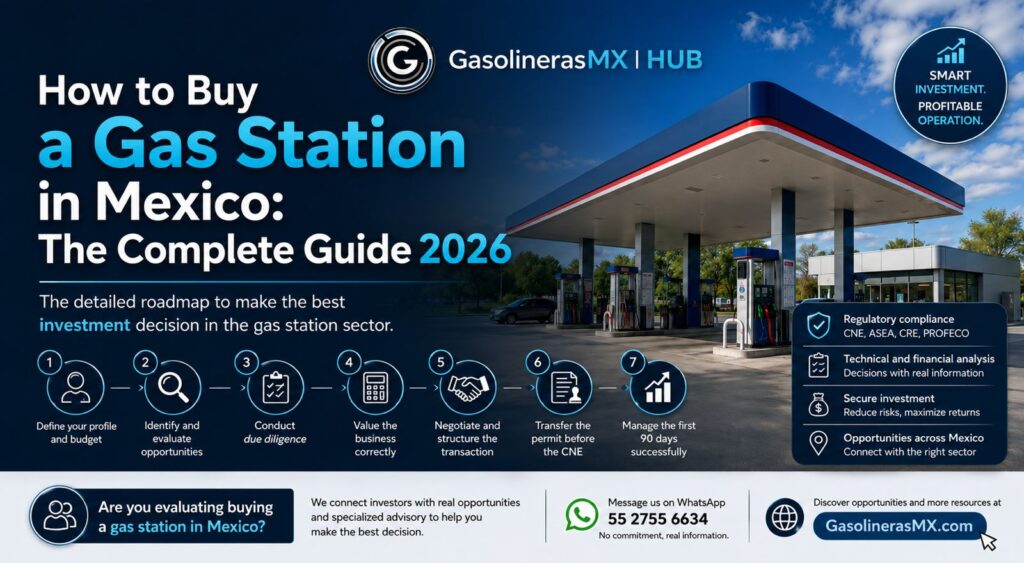
- Step 1: Define your investor profile and your real budget
- Step 2: Identify and evaluate opportunities
- Step 3: Due diligence — what to check before committing
- Step 4: Valuation — what the station is actually worth
- Step 5: Negotiation and deal structure
- Step 6: Transferring the permit with the CNE
- Step 7: Your first 90 days as the new owner
- The most common mistakes when buying a gas station
- Frequently asked questions
- Sources
What does “buying a gas station” in Mexico actually mean?
Before starting the process, it’s essential to understand exactly what you’re buying when you acquire a service station in Mexico — because the answer isn’t as obvious as it seems.
A gas station isn’t a business bought and sold like any other company. Its operation is regulated by a petroleum products retail permit issued by the CNE (Comisión Nacional de Energía), and that permit is the single most important asset of the operation. Without a current permit, there is no gas station — only a physical installation with tanks and dispensers that cannot legally operate.
This means that when you buy a gas station, you are essentially acquiring three distinct things:
- The physical asset: the installation, tanks, piping, dispensers, construction, and land — or the right to use the land if it’s leased.
- The operating business: the customer base, historical sales volume, active contracts (fuel supplier, brand flag, commercial units, fleet accounts), staff, and operating systems.
- The CNE permit: the legal right to operate as a retail petroleum products seller at that specific location. This is the hardest asset to replace — obtaining a new permit from scratch can take between 18 months and 3 years, with uncertain outcomes.
The legal structure of the purchase can take two main forms:
- Purchase of the operating business (assets): the physical assets and contracts are acquired, and the transfer or modification of the permit to the new operator’s name is requested from the CNE. This is the most common form.
- Purchase of the legal entity: the company itself (SA de CV, SAS de CV, or SAPI) that holds the permit is acquired directly. Faster in terms of permit transfer, but it means inheriting all of the company’s liabilities — tax, labor, and regulatory.
The decision on deal structure has significant tax, labor, and regulatory implications. It’s one of the first topics the buyer’s legal team should address — before any price negotiation.
📌 To understand the CNE permitting process: Permits and Regularization for Gas Stations in Mexico
The three types of opportunity: operating, in-process, and ground-up development
Not all purchase opportunities are the same. Before looking for a specific station, it’s important to understand what type of opportunity you’re evaluating — because the process, the risk, and the capital required are completely different.
Operating station
This is the most common option and the one this article covers in the most detail. The station already has a current CNE permit, already sells fuel, and already generates cash flow. The buyer acquires a functioning business and takes over operations from day one.
Advantages: cash flow from day one, verifiable sales history, permit already granted, working infrastructure.
Risks: higher price, possible hidden liabilities (labor debts, regulatory non-compliance, tanks in poor condition), dependence on the seller’s track record.
In-process station (permit pending)
The facility exists or is under construction, but the CNE permit is pending or has just been granted. The seller transfers the process before the station begins operating.
Advantages: lower price than an operating station, opportunity to define the business model from the start.
Risks: uncertainty around permit resolution timelines, possible technical or regulatory complications that delay opening, no cash flow during the process.
Ground-up development (land + project)
This isn’t strictly “buying a gas station” — it’s developing a new project. Land suited for a gas station is acquired and the permitting, construction, and opening process begins.
Advantages: maximum control over infrastructure and business model, ability to design the station to the latest standards.
Risks: the longest process (18 months to 3 years until first sale), the largest capital requirement, no income throughout development.
📌 For a detailed analysis of buying vs. building: Buy or Build a Gas Station in Mexico? Complete Analysis 2026
Step 1: Define your investor profile and your real budget
The first mistake most investors looking to buy a gas station make is starting with the search for stations before having clarity about their own profile. The result is wasted time evaluating opportunities that don’t match their capacity or expectations.
Define your total budget — not just the purchase price
A station’s acquisition price is only part of the capital required. A buyer’s real budget must include:
| Component | Rough range |
|---|---|
| Station purchase price | Variable — see valuation section |
| Initial working capital (fuel inventory) | $29,000 – $118,000 USD (~$500,000 – $2,000,000 MXN) |
| Regulatory retrofits (if the station has pending items) | $0 – $88,000 USD (~$0 – $1,500,000 MXN) |
| Legal and notarial fees | $4,700 – $14,700 USD (~$80,000 – $250,000 MXN) |
| Technical and financial due diligence | $2,900 – $8,800 USD (~$50,000 – $150,000 MXN) |
| Operating reserve (first 3–6 months) | $17,600 – $47,000 USD (~$300,000 – $800,000 MXN) |
A station advertised at $470,000 USD ($8,000,000 MXN) may require a total outlay of $588,000 – $647,000 USD ($10,000,000 – $11,000,000 MXN) to be properly operational. Buyers who don’t account for this from the start arrive undercapitalized at closing.
Define your return expectations and time horizon
A gas station is not a short-term investment. The typical payback horizon in the sector ranges from 5 to 12 years, depending on sales volume, the operating model, and the acquisition price.
Before searching, answer:
- Are you looking for an asset that generates monthly cash flow, or long-term capital appreciation?
- Do you have the capacity and willingness to operate the station directly, or are you looking for a delegated management model?
- What’s your investment horizon: 5, 10, or 15 years?
- Do you have experience in the sector, or is this your first deal in this market?
Define your geographic area
Gas stations aren’t interchangeable by location. A station in a high-traffic metropolitan zone, on a national highway corridor, or in a fast-growing mid-sized city each has a completely different risk profile, price, and return potential. Defining the area before searching saves weeks of irrelevant evaluations.
📌 To understand which location factors affect profitability: How to Choose the Ideal Site for a Gas Station in Mexico
Step 2: Identify and evaluate opportunities
With your profile defined, the next step is finding stations that match it. Mexico’s gas station M&A market is discreet by nature — most deals aren’t publicly advertised, and sellers generally prefer confidential processes.
Where opportunities are found
- Specialized sector platforms: like GasolinerasMX | HUB, where owners and operators publish buy, sell, and lease opportunities with basic business information. It’s the most efficient channel for accessing a curated inventory of available stations.
- Specialized intermediaries and brokers: people or firms with sector networks who know about opportunities before they’re published. They charge a commission on the transaction value — typically between 2% and 5%.
- Sector contact networks: station owners, fuel distributors, infrastructure suppliers, and organizations like ONEXPO frequently have information about stations for sale before they reach the market.
- Lawyers and notaries specialized in hydrocarbons: they handle purchase-sale transactions and may know of opportunities in process.
The first-round evaluation: what to ask before going deeper
Before investing time in full due diligence, there are first-round questions that determine whether an opportunity merits further attention:
- What’s the average monthly sales volume in liters, verifiable with distributor account statements?
- Is the CNE permit current, and in whose name? Does it have observations or open proceedings?
- Does the station have a current IPP (Periodic Preventive Report) issued by a verification unit accredited by ASEA?
- What’s the reason for the sale? Are there debts, labor disputes, or pending regulatory proceedings?
- Is the station flagged under a brand? What are the terms and duration of the image and supply contract?
- Is the land owned by the seller or leased? If leased, what are the term and renewal conditions?
A vague, incomplete answer — or one that raises more questions — on any of these points is a red flag that should be resolved before moving forward.
📌 See available buy, sell, and lease opportunities: Gas Stations Available in Mexico
Step 3: Due diligence — what to check before committing
Due diligence is the process of thoroughly verifying every aspect of the station before committing to a firm offer. It’s the most critical stage of the process — and the one most frequently underestimated by buyers who fall in love with the sales numbers without checking what’s behind them.
Complete due diligence for a gas station in Mexico covers four dimensions:
- Regulatory due diligence
- CNE permit: verify its validity, conditions, restrictions, and confirm there are no revocation, suspension, or modification proceedings underway. Request a certified copy and verify directly in the CNE’s system.
- NOM-005-ASEA-2016 compliance: verify that the IPP is current and there are no pending ASEA observations. Request the inspection history for the last 3 years.
- NOM-016-CRE-2016 compliance: verify that the Annual Quality Report has been filed and is current, and that quarterly sampling is up to date.
- PRONAGAS: verify the status of registration in the National Gas Facilities Registry.
- Single Environmental License (LAU): verify it’s current with SEMARNAT.
- Tax status: verify the company has no tax liens, active audit proceedings, or discrepancies with the SAT, including volumetric control compliance.
📌 To understand full regulatory compliance: NOM-005-ASEA-2016 and NOM-016-CRE-2016
- Technical due diligence
- Underground tank condition: age, type (single or double wall), interstitial monitoring system, tightness test history, evidence or absence of historical leaks. This is the highest technical-risk component — a leaking tank can lead to soil remediation costs that exceed the value of the business.
- Piping and connections condition: visual and documentary inspection, maintenance history.
- Dispenser condition: age, certifications, automatic shutoff systems, maintenance history.
- Vapor Recovery System (VRS): installation and current efficiency test status.
- Electrical installations: classification for explosive zones, general condition.
- Monitoring wells: number, location, latest sampling results. A positive hydrocarbon result in the monitoring wells is a major red flag — it may indicate active soil contamination.
Technical due diligence should be carried out by a company specialized in service-station infrastructure, not a general civil engineer. The cost runs $1,700 to $4,700 USD (~$30,000 to $80,000 MXN) — always worth it.
- Financial and operational due diligence
- Sales volume: verify the last 24 months of sales with distributor account statements or volumetric control records. The numbers the seller presents are their version — the distributor’s account statements are reality.
- Cost structure: real (not theoretical) margin per liter, fixed and variable operating costs, payroll, utilities, maintenance, lease (if applicable).
- Active contracts: review all active contracts — fuel supply, brand image, commercial units, fleet accounts, land lease. Verify terms, transfer conditions, and early-termination clauses.
- Labor liabilities: review employee registration with IMSS, seniority, contracts, and any active or potential labor claims.
- Financial statements: if the station operates as a legal entity, review the financial statements for the last 3 years and the corresponding tax filings.
- Legal due diligence
- Land title (or lease agreement with verified conditions): check the Public Property Registry to confirm there are no liens, mortgages, attachments, or active litigation over the property.
- Corporate structure: verify the seller has the legal authority to sell and that there are no partners, creditors, or family members with rights over the business who aren’t at the table.
- Active litigation: review the history of civil, commercial, labor, and administrative claims.
Due diligence isn’t a formality — it’s the only chance you have to discover what the seller isn’t telling you. Buyers who skip it or do it superficially inherit the previous owner’s problems from day one.
Step 4: Valuation — what the station is actually worth
Correctly valuing a gas station is one of the most critical skills in the buying process — and one of the hardest to exercise without sector experience. The price the seller is asking is not the valuation. It’s their negotiating expectation.
There are three valuation methods most commonly used in Mexico’s gas station sector, and each offers a different perspective. A sophisticated buyer uses all three as complements to one another.
Method 1: EBITDA multiple
This is the most widely used method in mid- and high-volume gas station transactions. It’s calculated on the operation’s real EBITDA (not the tax-declared figure, but the economic one), applying a multiple that in the Mexican gas station sector typically ranges from 4x to 8x, depending on:
- Sales volume and its trend
- Infrastructure quality
- Location and its potential
- Regulatory status
- The flag brand and contract conditions
A station with monthly EBITDA of $11,700 USD ($200,000 MXN) — $141,000 USD ($2,400,000 MXN) annually — at a 5x multiple has a business value of $706,000 USD (~$12,000,000 MXN) — not counting the land value if it’s owned by the seller.
Method 2: Replacement value
Calculates how much it would cost to build the same station from scratch at the same location. It includes land value, civil construction, tanks, piping, dispensers, brand image, and permits. This is the valuation floor — no rational buyer would pay more for an operating station than it would cost to build a new one, unless the value of the going concern and the permit justify the difference.
Method 3: Discounted cash flow (DCF)
Projects the business’s future cash flows and discounts them to present value using a rate that reflects sector and asset-specific risk. It’s the most technical method and the one that best captures the business’s value as a cash-flow generator — but it requires assumptions about volume growth, margin evolution, and infrastructure lifespan that must be grounded in real data.
📌 To dig deeper into valuation methodologies: How Is a Gas Station Valued in Mexico? Complete Methodology 2026
Step 5: Negotiation and deal structure
With due diligence complete and valuation in hand, the buyer has, for the first time, enough information to negotiate from a position of knowledge — not trust. That’s exactly the right position to be in.
The letter of intent (LOI)
Before formal negotiation begins, it’s common to issue a Letter of Intent setting out the general terms of the deal: indicative price, structure (asset purchase or entity purchase), conditions precedent, and an exclusivity period. It isn’t binding on price, but it does establish the negotiation framework and protects the buyer from the seller continuing to shop the deal while due diligence advances.
Common payment structures in the sector
100% cash at closing is the norm for deals under $5,000,000 MXN. For larger deals, the most common structures are:
- Payment at closing plus holdback: a portion of the price (typically 10–20%) is held in escrow for 6 to 12 months as security against hidden liabilities or breaches of seller representations.
- Deferred payment: part of the price is paid in installments, generally conditioned on post-closing performance metrics (sales volume, EBITDA).
- Bank financing: some financial institutions offer credit for gas station acquisitions, with the asset as collateral. Access to this financing requires solid credit history and audited financial statements for the business being acquired.
Price adjustments arising from due diligence
If due diligence reveals regulatory non-compliance, infrastructure in worse condition than expected, or sales volumes lower than declared, the buyer has grounds to request price adjustments. This is the most important practical function of due diligence — not just uncovering problems, but quantifying them for negotiation.
The purchase agreement
It should be drafted by a lawyer specialized in energy and commercial law, and should include at least:
- Detailed description of the assets being transferred
- Seller representations and warranties about the business’s regulatory, tax, and legal status
- Post-closing price adjustment mechanisms
- Seller non-compete clauses
- Conditions precedent to closing (including CNE permit transfer)
- Penalties for breach
Step 6: Transferring the permit with the CNE
This is the step that most frequently surprises buyers without sector experience — and the one that most frequently causes closing delays.
CNE permit transfer isn’t automatic. It doesn’t happen as a consequence of the purchase agreement. It requires a formal process before the Comisión Nacional de Energía, with specific documentation, and has its own resolution timelines that are independent of the commercial transaction’s timeline.
What does the permit transfer involve?
It depends on the deal structure:
- If the permit-holding legal entity is purchased: technically, the permit doesn’t change ownership — it remains the same company. What changes is the shareholder composition. However, the CNE requires notification of changes in shareholder control and may request additional documentation.
- If assets are purchased: the buyer must request that the CNE modify the permit to reflect the new holder. This process can take between 3 and 8 months under normal conditions.
Documentation generally required by the CNE
- Formal request for permit transfer or modification
- Articles of incorporation and powers of attorney for the new holder
- Official identification of the legal representative
- Purchase agreement or notarial instrument evidencing the transfer
- Documents evidencing ownership or right of use of the property
- Regulatory compliance status (current IPP, quality report)
- Payment of corresponding fees
Can the station operate during the transfer process?
This is the most common practical question. In many deals, the buyer begins operating the station under the seller’s permit (through a transitional operating or lease agreement) while the formal transfer with the CNE is resolved. This practice is common but carries legal risks that must be clearly managed in the agreement between the parties.
Permit transfer must be built in as a condition precedent or a post-closing obligation in the purchase agreement, with clearly defined timelines, responsibilities, and penalties. Closing without this mechanism is one of the most costly mistakes a buyer can make.
Step 7: Your first 90 days as the new owner
Signing the contract and receiving the keys isn’t the end of the process — it’s the start of the stage most critical to the investment’s long-term profitability.
The first 72 hours
- Conduct a complete physical fuel inventory in the tanks, with independent measurement.
- Verify the operating condition of all dispensers and systems.
- Review the station’s document file and make sure you hold the critical documents: CNE permit, IPP, Annual Report, active contracts.
- Notify your fuel distributor of the change of ownership and confirm supply terms.
- Inform fleet customers with active contracts of the change.
The first week
- Update authorized signatories on bank accounts and contractual relationships.
- Review payroll status and employee registration with IMSS.
- Confirm the IPP status and regulatory deadline calendar with your accredited verification unit.
- Set up the operating logbook system if it doesn’t exist or is out of date.
The first 30 days
- Conduct the first tank sampling with an accredited laboratory under your own management.
- Verify dispenser condition with a metrology company.
- Evaluate the status of the brand-flag agreement (if any) and its real conditions.
- Establish or update the Emergency Response Plan.
The first 90 days
- Evaluate actual sales volume performance against due-diligence projections.
- Identify the main operational improvement opportunities.
- Evaluate whether the current brand-flag model is optimal for the station or whether alternatives would improve the cost-and-margin equation.
- Set the annual regulatory compliance calendar.
📌 For a full operational compliance checklist: How to Prepare Your Gas Station for an ASEA or CNE Inspection
The most common mistakes when buying a gas station
These are the patterns that repeat most often in deals that go wrong — or that generate significant problems in the first years of operation.
Mistake 1: Trusting the seller’s numbers without independent verification
The sales volume declared by the seller must be verified against distributor account statements, volumetric control records, or both. A 10–15% difference between declared and actual volume can completely change the valuation and the purchase decision.
Mistake 2: Underestimating regulatory status
A station with an expired IPP, a pending Annual Report, or open ASEA proceedings isn’t just the seller’s problem — from the moment of closing, it becomes yours. The cost of bringing a station with multiple non-compliances into good standing can easily exceed $29,000 USD (~$500,000 MXN), not counting the risk of closure during the process.
Mistake 3: Not checking tank condition
This is the highest-risk technical component and the one most frequently skipped in superficial due diligence. A tank with a history of leaks or active soil contamination can generate remediation costs that exceed the value of the business. Specialized technical inspection of tanks and piping is not optional.
Mistake 4: Not reviewing the land lease agreement
Many gas stations operate on leased land. A lease with a short term, no renewal clause, or terms unfavorable to the tenant can destroy the business’s value if the landowner decides not to renew or significantly raises the price.
Mistake 5: Closing without a clear permit transfer mechanism
Already mentioned, but worth repeating: buying a gas station without a clear, contractually backed mechanism for CNE permit transfer is like buying a car without being handed the keys.
Mistake 6: Undercapitalizing at closing
Putting all available capital toward the purchase price and arriving at month one without operating reserves is one of the most frequent mistakes. A newly acquired gas station inevitably has unforeseen expenses in the first months — maintenance, regularization, working capital. Without reserves, these expenses become a crisis.
Mistake 7: Ignoring the brand-flag model
The image and supply contract with a flag brand has a direct impact on operating margin, supplier freedom, and strategic flexibility. Buyers who don’t carefully read that contract before closing frequently discover conditions they didn’t expect in day-to-day operations.
📌 To understand the implications of brand flagging: Why Is Your White-Flag Station Losing Customers?
Frequently asked questions
How much does a gas station cost in Mexico in 2026?
The range is very wide. A small station in a mid-sized city can be found between $235,000 and $470,000 USD ($4,000,000 and $8,000,000 MXN). A mid-sized station in a metropolitan area with good volume can cost between $706,000 and $1,765,000 USD ($12,000,000 and $30,000,000 MXN). High-volume stations in strategic locations can exceed $2,940,000 USD (~$50,000,000 MXN). Price depends mainly on sales volume, location, infrastructure condition, and regulatory status.
How long does the purchase process take?
Between identifying the opportunity and operating under the new owner, a well-executed process takes between 3 and 8 months. Full due diligence requires 4 to 8 weeks. Negotiation and contractual closing, an additional 2 to 4 weeks. CNE permit transfer, 3 to 8 months after closing.
Do I need sector experience to buy a gas station?
It isn’t essential, but it’s highly recommended to have advisors with sector experience — legal, technical, and financial. The gas station sector has regulatory, technical, and operational specifics that aren’t intuitive for investors experienced in other sectors.
Can I finance the purchase with a bank loan?
Yes, although access to bank financing for gas station acquisitions requires meeting solid requirements: credit history, audited financial statements for the business being acquired, and sufficient collateral. Some institutions specialized in business financing have specific lines for the energy sector.
What happens to the station’s employees when ownership changes?
It depends on the deal structure. In an asset purchase, the new owner has no automatic obligation to keep the employees, but may face labor claims if contract terminations aren’t handled correctly. In an entity purchase, labor contracts are inherited. In both cases, labor treatment must be clearly defined in the purchase agreement.
Can I buy a gas station if I’m not Mexican?
Foreigners can be partners or shareholders in a Mexican legal entity that holds a CNE permit, subject to the restrictions that apply to foreign investment in the energy sector. The CNE grants permits to legal entities incorporated under Mexican law. This is a topic that requires legal advice specialized in foreign investment and energy law.
What’s the typical return on investment for a gas station?
Return on investment (ROI) for gas stations in Mexico varies significantly by volume, location, and acquisition price. In well-structured deals, annual free cash flow on invested capital ranges from 8% to 18%. The typical payback period is 5 to 10 years.
What’s the difference between buying the company and buying the assets?
Buying the company (legal entity) transfers CNE permit ownership more directly, but also transfers all historical liabilities — tax, labor, and regulatory. Buying the assets requires a permit modification process with the CNE, but allows the buyer to start without inherited liabilities. The choice depends on the selling company’s condition and the buyer’s priorities.
Sources
- CNE – Petroleum products retail permits, procedures and requirements: gob.mx/cne
- Hydrocarbons Law – Permit regime, transfers, and penalties: diputados.gob.mx
- ASEA – NOM-005-ASEA-2016, requirements for service station operation: gob.mx/asea
- PROFECO – Metrological verification of dispensers: gob.mx/profeco
- SAT – Volumetric control for gas stations, tax obligations: sat.gob.mx
- SEMARNAT – Single Environmental License for service stations: gob.mx/semarnat
- CNH – Hydrocarbons sector statistics in Mexico: gob.mx/cnh
- Public Property Registry – Verification of liens on real estate: registropublico.cdmx.gob.mx
About GasolinerasMX | HUB
GasolinerasMX | HUB is the leading ecosystem for the gas station sector in Mexico. We support owners, investors, operators, and suppliers at every stage of the business, with personalized follow-up on every transaction and the backing of a network of more than 5,000 active contacts.
At GasolinerasMX | HUB you’ll find:
- Brokerage for buying and selling gas stations
- Brokerage for leasing gas stations
- Land for gas station development
- Specialized services: regulatory compliance, permits, volumetric control, rebranding, and infrastructure
- Available investment opportunities
- GasolinerasMX | HUB Supplier Directory — our network of specialized partners
Looking to buy, sell, or lease a gas station, need to comply with current regulations, or want to connect with specialized suppliers in the sector?
Contact us at GasolinerasMX.com or write to us directly on WhatsApp at +52 55 2755 6634.
¿Desea posicionar su empresa en el sector gasolinero?
Publique su empresa en el directorio B2B de GasolinerasMX | HUB y conecte con proveedores, operadores, inversionistas y compradores activos en México.
Ver planes y precios